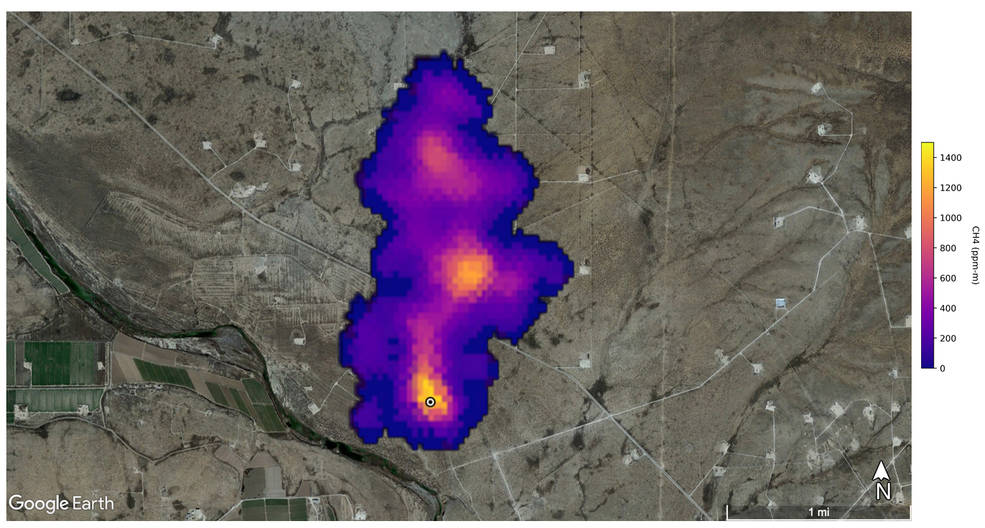
[caption id="attachment_429384" align="alignleft" width="610"] This image shows a methane plume 2 miles (3 kilometers) long that NASA’s Earth Surface Mineral Dust Source Investigation mission detected southeast of Carlsbad, N.M.. Methane is a potent greenhouse gas that is much more effective at trapping heat in the atmosphere than carbon dioxide. (Credit: NASA/JPL-Caltech)[/caption]
NASA’s Earth Surface Mineral Dust Source Investigation (EMIT) mission is mapping the prevalence of key minerals in the planet’s dust-producing deserts—information that will advance our understanding of airborne dust’s effects on climate. But EMIT has demonstrated another crucial capability: detecting the presence of methane, a potent greenhouse gas.
In the data EMIT has collected since being installed on the International Space Station in July 2022, the science team has identified more than 50 “super-emitters” in Central Asia, the Middle East and the Southwestern United States. Super-emitters are facilities, equipment and other infrastructure—typically in the fossil-fuel, waste or agriculture sectors—that emit methane at high rates.
Methane ‘Super-Emitters’ Mapped by NASA’s New Earth Space Mission